
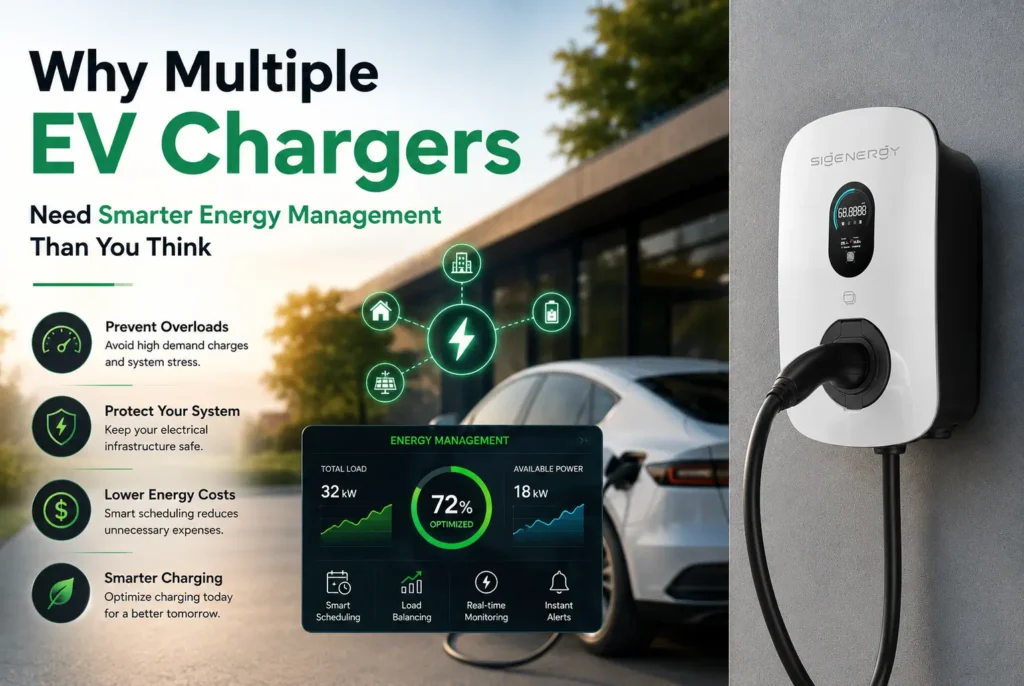

Electric cars have now become an essential part of our lives. Some years ago, there was only one vehicle that the family could consider using. However, today it has now become increasingly common for families to have two electric vehicles, while small businesses start installing chargers for their employees or customers’ use.
At first thought, adding another charger to the garage or business place would not be that difficult since the current one is working well. However, it is often not that simple because it does not depend on the location of the charger, but rather on whether the house has enough electrical capacity to provide power to all vehicles.
Now that more and more houses are adopting electric vehicles, electricity becomes an equally essential issue as the selection of a charger.
Table of Contents
Why More Chargers Can Create Bigger Problems
Most people believe that electric cars will only affect their electricity bill, making it higher each month. While the electricity usage may go up, what people do not understand is peak demand. Peak demand is defined as the maximum amount of electricity used by your premises at any one time. Think about coming home from work at 6 p.m., plugging in one car while your spouse plugs in another. At the same time, you have the air conditioner on, cooking food, the dishwasher running, and washing clothes.
Now, you have many electrical appliances vying for electricity all at once. While your two vehicles may need only a partial charge for the night, the two chargers will start drawing a lot of electricity at once. This will put a lot of strain on the electrical system, much more than the total electricity consumption in a day would indicate.
What Is Load Management?
Load management essentially refers to the management of the timing and way in which electrical devices consume electricity. In place of letting all the chargers and appliances work at full capacity together, the technology ensures that the electricity is used more effectively.
It can be compared to traffic control during rush hour. The absence of traffic lights will mean that all vehicles attempt to pass through an intersection at once, which leads to chaos and delays. Traffic lights do not decrease the number of cars; they only regulate the flow.
This is the way electricity functions, too. Load management does not lower the energy you have in your vehicles; it only organizes its consumption.
Homes Are Starting to Look Like Small Businesses
In the past, advanced energy management systems have been limited to commercial and industrial applications. Manufacturing plants, office buildings, shopping complexes, and warehouses are usually equipped with systems that help to control their electricity usage. However, nowadays, even many homes are confronted with this kind of problem.
For instance, consider a home that features:
- Two electric cars
- A rental unit
- Solar panels on the roof
- Battery storage system
- Office equipment
- Smart appliances
Such a configuration differs significantly from that of a standard house.
The same applies to facilities like:
- Medical clinics
- Workshops
- Farm offices
- Apartments
- Parking facilities
- Business fleets
These facilities are relatively small in size, but energy management becomes crucial when a number of charging stations are added.
Why Charging at the Same Time Isn’t Always Necessary
The reality is that most drivers do not need the maximum charging rate each evening. In the case where both cars need sufficient power to make their commutes the following day, there might be eight to ten hours overnight to get charged. Instead of having two chargers work at full capacity when everyone gets home, It can:
- Slow down charging during peak hours at home
- Charge one car first, then move on to the next.
- Utilize off-peak electricity prices.
- Utilize solar power.
- Do not overload the electrical system.
It will leave you with the same cars charged but without overworking the electrical systems on the property.
Questions Worth Asking Before Installing Multiple Chargers
Before installing more EV chargers, it pays to move past the initial cost of installation. Here are some questions worth asking yourself:
- Do all cars necessarily require immediate charging?
- Are there other people who will use the charging stations?
- Will visitors have access to a charge?
- Is there a need for sharing electricity costs?
- Can rooftop solar systems cut down charging costs?
- Can battery storage systems come in handy during power outages?
- What types of equipment should get priority in case of an electricity shortage?
These are not just technological considerations. They impact convenience and future costs. Smart planning can save you much more money than future upgrades.
Smart Energy Systems Make Daily Life Easier
Modern energy management systems do far more than control the chargers. This is where smart EV charging options stand out. They automatically manage power distribution, schedule charging during off-peak hours, and work in tandem with solar panels or battery storage to help easily charge several vehicles while not overloading your electrical infrastructure.
A lot of them can also monitor electricity consumption across the whole property. In case the household demand spikes, the speed at which vehicles get charged may be temporarily slowed down until demand drops.
Some of them even coordinate various sources of energy, such as:
- Solar panels
- Home batteries
- EV chargers
- Backup power
- Appliances in a house
Everything works in harmony rather than fighting for the electricity. Such systems save a lot of guessing for larger households and small businesses.
Where an Energy Gateway Fits In
With advancements in charging technology, some installations need a central energy management system. One such system is the Sigenergy Business Energy Gateway, which assists in managing different types of energy assets within a property. Unlike individual chargers, a gateway makes communication between different systems possible.
Depending on how the system is installed, it can manage:
- EV charging schedule
- Storage battery utilization
- Power backup preferences
- Energy tracking and monitoring
- Visibility of systems
- Distributing power
It is especially useful in places where there are several drivers, tenants, workers, or fleet cars. The aim here is not just to add chargers but to ensure efficient energy utilization in its entirety.
Solar and Battery Storage Add Even More Flexibility
Those who consider installing several EV charging stations at once also think about getting some solar panels. However, without proper organization, solar power generation will not necessarily be synchronized with charging needs. A car might start charging after dark hours when solar power generation is no longer taking place.
Storage capacity makes the difference. It is possible to store the excess solar power generated during the day and use it to charge EVs at night. This method, together with optimal load management, helps to use renewable power more efficiently.
Planning for the Future Matters
The global shift towards electric vehicle adoption is accelerating rapidly, transforming transportation for a cleaner, sustainable future. Based on forecasts made by the National Laboratory of the Rockies, there may be about 33 million electric vehicles on the roads by 2030, with some 28 million charging spots, where the vast majority of charging will happen either at home or at work.
This doesn’t have to imply any major electrical upgrades for all buildings. What it does imply, however, is the likelihood of demand spikes caused by charging without management, which could have been prevented with proper planning. Adding a second charger right now might not seem like a big deal, but needs tend to change much faster than one might think.
- An extra electric car could be added at home.
- More tenants could move into the rented building.
- A business could acquire additional vehicles for its use.
- Getting ready for that now makes things easier in the future.
Final Thoughts
Installing several EV chargers is no longer uncommon. As electric cars become an integral part of people’s transport needs, homeowners and smaller business owners will put higher strains on the electrical installations in their premises. Fortunately, there is no need for more powerful electrical service.
Load optimization means that the process of charging will be more efficient through the coordination of electricity consumption as opposed to letting each charger utilize the maximum amount of power simultaneously. Whatever the purpose – whether the need is about saving money, skipping extra electrical work, implementing solar panels, or looking into the future, good planning in this area could have a big impact.
Before installing more chargers, consider not only the current number of needed chargers but also how your energy needs might change in the upcoming years.
Frequently Asked Questions
Is it okay to charge two electric vehicles at the same time?
Yes, it depends on the capability of your home’s electrical infrastructure. If the chargers work at full capacity while some other devices are working, there will be additional peak electricity consumption. However, a proper load management system will handle the situation easily and effectively.
What is EV load management?
EV load management is a way of controlling the amount of electricity used by the electric car chargers at the moment. Instead of giving access to the electricity at full power to all chargers simultaneously, the available amount of electricity is distributed.
Do I need a service upgrade for multiple EV chargers?
No, you do not always need to upgrade your electrical service. However, an electrical assessment can be performed to see if you have enough capacity.
Can smart EV charging reduce electricity costs?
Absolutely. Intelligent electric car charging will allow us to charge the cars during off-peak times when the cost of electricity is cheaper. Moreover, it will enable integration of the charging process with either solar panels or energy storage.
How does solar power work with EV charging?
They produce electricity only during the daytime. However, by combining them with energy storage, we can save the electricity generated and use it for electric car charging later.